
Your team needs a feature. Two months later, it’s still stuck because nobody understands the code. Does this situation feel familiar? That’s debt in action. It makes releases slower. Makes maintenance more expensive.
Legacy application modernization signifies modernizing, remodeling, or migrating older software systems. It is created for software that no longer meets current business or security parameters. It improves system performance, security, and scalability. It also reduces high maintenance costs and operational difficulties.
Outdated systems can be replaced or completely retired when necessary. It doesn’t always mean a rewrite. It isn’t the same as cloud migration, which moves workloads but may leave the code unchanged. This guide covers strategies, migration risks, security, cost, and how to choose a partner for legacy application modernization USA projects.
What Makes an Application Legacy?
A legacy application is software that’s hard, risky, costly, or slow to maintain and change. Age alone doesn’t make it legacy. An older system can continue to be useful if it has support, is safe, can be checked, and matches what the business needs.
Technical debt is the money you will have to pay because of fast solutions, not enough documentation of how things work, and things that are no longer up to date. Old systems build up this debt quickly.
Characteristic | Why It Matters |
Unsupported runtime | Security patches and specialist support may be unavailable |
Poor documentation | Changes become slower and riskier |
Fragile integrations | Small updates can disrupt dependent systems |
Signs Modernization Is Needed
How do you know if your application needs modernization? Check for technical and business warning signs.
Technical signs:
- Unsupported operating systems, frameworks, or databases.
- Recurring defects and outages.
- Manual releases and missing automated tests.
- Hard-coded credentials and weak monitoring.
Business signs:
- Slow feature delivery and rising maintenance costs.
- Dependence on a few specialists.
- Customer or employee workarounds.
- Trouble supporting new products, analytics, or AI.
- Compliance or audit concerns.
Prioritize by business impact, not age alone.
Benefits of Modernization
Why should companies modernize legacy applications? The benefits depend on the strategy and the quality of execution. Well-run software modernization services can deliver:
- Lower technical and operational risk.
- Stronger security and easier patching.
- Faster development and releases.
- Better performance and scalability.
- Easier integration through APIs.
- Access to cloud, analytics, automation, and AI.
Modernization doesn’t always cut total cost. Spending may rise first for discovery, testing, data work, security, parallel operations, and training. Track release frequency, reliability, recovery time, and operating cost.
Modernization Strategies
Selecting an application modernization strategy begins with the 7 Rs. It’s a common structure for cloud resettlement plans. These options range from retaining or retiring legacy software to moving, repurchasing, or completely rebuilding applications for the cloud.
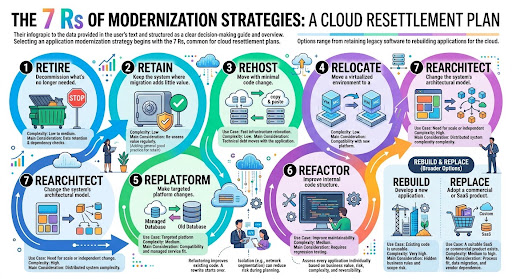
Rebuild and replace are broader modernization options.
- Rehost: Move with minimal code change
- Relocate: Move a virtualized environment to a compatible platform.
- Replatform: Make targeted platform changes, like a managed database
- Refactor: Improve internal code structure
- Rearchitect: Change the system’s architectural model
- Rebuild: Develop a new application.
- Replace: Adopt a commercial or SaaS product.
- Retire: Decommission what’s no longer needed.
- Retain: Keep the system where migration adds little value.
Refactoring improves existing code. A rewrite starts over. Isolation, such as network segmentation, can reduce risk while you plan.
How To Choose a Strategy
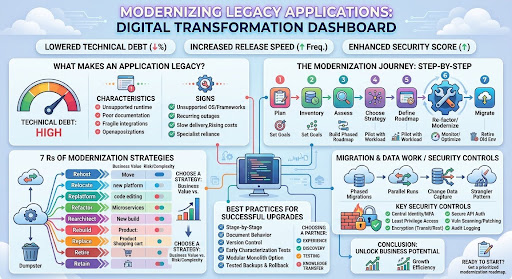
Which modernization strategy is best? Choose based on business value, risk, complexity, and reversibility.
Assess every application individually. Consider how important it is to the business, how often it changes, how much security risk it has, how complicated it is to connect with other systems, how good the data is, how much testing has been done, and how long the system can be down before it causes problems.
A group of applications can use approaches at the same time. You might rehost a low-change utility and retire a duplicate tool.
When uncertainty is at its peak, start with a small and clear plan. Select client service architecture only when independent placement, scaling, or ownership justifies the added complexity.
Modernization Process
Any enterprise legacy software migration works better with a clear sequence. So how do you modernize a legacy application? Follow these steps:
- Set business goals, ownership, governance, and success metrics.
- Inventory applications, databases, APIs, users, and dependencies.
- Assess code quality, technical debt, data, vulnerabilities, and test coverage.
- Choose a strategy and define the target architecture.
- Build a phased roadmap with migration waves and rollback criteria.
- Build the testing foundation before major changes.
- Modernize data, APIs, security, and infrastructure.
- Pilot with a limited but representative workload.
- Migrate in controlled waves and validate functionality, data, performance, and security.
- Monitor, optimize, and retire the old environment only after operational acceptance.
Migration and Cloud
Is cloud migration the same as modernization? No. Rehosting can move an application to the cloud without improving it. So the technical debt moves along.
Common patterns include phased migration, parallel runs, change data capture, blue-green deployment, and canary releases. The strangler pattern replaces old functions piece by piece.
Data work needs schema mapping, cleansing, encryption, reconciliation, validation, and tested backups.
Downtime depends on data volume, synchronization, dependencies, and cutover design. So don’t assume zero downtime.
A rollback plan should cover traffic reversal, data reconciliation, integration restoration, and tested recovery. A backup isn’t a rollback plan until you’ve restored and validated it.
Cost Factors
How much does legacy application modernization cost? There’s no reliable universal price. Scope, risk, integrations, data, and strategy set the estimate. Costs may rise before benefits appear. Ask any provider of software modernization services for an assessment-based estimate.
Factor | Impact |
Technical debt | Increases discovery, refactoring, testing, and remediation effort |
Integrations | Adds dependency mapping, API, contract, and end to end testing work |
Data migration | Adds mapping, cleansing, synchronization, validation, and reconciliation |
Infrastructure | Affects cloud design, networking, licensing, resilience, and operations |
Security | Adds identity, encryption, vulnerability remediation, compliance, and monitoring |
Team expertise | Specialist shortages can increase duration and external services needs |
Parallel operations | Increases infrastructure, support, monitoring, and reconciliation costs |
Security Risks
What are the security risks of legacy applications? They include unsupported software, obsolete protocols, weak authentication, excessive privileges, exposed APIs, hard-coded secrets, flat networks, and missing logs.
Key controls include:
- Central identity and MFA.
- Least privilege access.
- Encryption in transit and at rest.
- Secrets and key management.
- Secure API authentication and authorization.
- Vulnerability scanning and patching.
- Audit logging and monitoring.
Address security before, during, and after migration. Modernization doesn’t secure an application on its own.
Best Practices
What are the best practices for legacy application modernization? These support any application modernization strategy:
- Modernize in stages, not with a big bang rewrite.
- Document behavior, dependencies, data flows, and business rules.
- Keep code, configuration, infrastructure, and scripts in version control.
- Write characterization and end-to-end tests early.
- Preserve existing behavior before adding features.
- Consider a modular monolith when microservices add needless complexity.
- Maintain tested backups and a realistic rollback path.
- Use feature flags, canary releases, or parallel runs where they fit.
- Add observability before cutover.
- Assign clear ownership across business, security, data, cloud, and operations teams.
Choosing a Modernization Partner
How do you choose a legacy application modernization company? Judge providers on proven capability, not rankings alone. Look for:
- Relevant technology and industry experience.
- Strong legacy system discovery.
- Cloud, data migration, and API expertise.
- Security and compliance maturity.
- Automated testing and CI/CD practices.
- Knowledge transfer and post-launch support.
Ask how they handle undocumented business logic, scope changes, and failed cutovers. Require a discovery phase before accepting a full estimate. A reliable legacy system upgrade company will welcome that. For legacy application modernization USA projects, also check US industry and compliance experience.
Final Thoughts
Unaddressed technical debt and outdated software can stall your business growth, lower security, and increase operational costs. Partnering with a reliable legacy application modernization USA provider helps you choose the right strategy, lower risk, and modernize smoothly.
By following a structured roadmap, you can transform fragile systems into secure, scalable, and future-ready applications. Request a comprehensive assessment today to take control of your software architecture and unlock your company’s full potential.
Ready to Start?
Ask for a legacy application assessment. Code Avenue will guide you in the best way. You will receive a prioritized modernization roadmap. The modernization roadmap contains a legacy application inventory, a security review, strategy options, a migration plan, and cost assumptions.
So, don’t wait. Start a free consultation today and get the best application for your business.
FAQs
What is legacy application modernization?
It means updating, transforming, migrating, replacing, or retiring software so it meets current business needs. It doesn’t always require a full rewrite.
Is cloud migration the same as application modernization?
No. Cloud migration moves an application or infrastructure. Modernization can also change code, architecture, data, integrations, and security.
Should a company refactor, rewrite, or replace a legacy application?
It depends on code condition, business criticality, test coverage, and available products. Don’t default to a rewrite.
How much does legacy application modernization cost?
Cost varies by strategy, complexity, data, integrations, security, and testing. An assessment gives a far better estimate than generic prices.
How can enterprises move a legacy application without any downtime?
Enterprises can try a phased migration, capture changes in data-run systems, or use blue‑green and canary releases while keeping clear rollback triggers. Enterprises should remember that zero downtime cannot be assumed everywhere.
What are the biggest legacy modernization risks?
Hidden business logic, incomplete dependency mapping, data inconsistency, weak testing, scope creep, and poor rollback planning top the list.
Is microservices architecture required for modernization?
No, it’s optional. A modular monolith can fit better when boundaries and operations don’t justify distributed complexity.








They were willing to walk me through their ideas and provide suggestions when I wasn't sure about something.
Marcus Gitau Founder, Kumea, Agriculture Industry