

Process, pricing, HIPAA compliance, and the features that actually matter. A practical guide to healthcare app development in the USA.

How long does it really take to build a patient app? Longer than the coding, that’s for sure. Security reviews, HIPAA checks, EHR connections, and testing eat up most of the time. Many founders learn this only after a quote doubles once compliance comes into play. Healthcare app development in the USA involves more moving parts than a typical consumer app. I see that this happens because patient data, clinical workflows, and federal privacy rules are all in play. In this blog, we’ll cover the process, real costs, HIPAA requirements, and the key features that matter most.
Start With the Right Healthcare App Plan
Healthcare app development is the process of building software for patients, providers, or health organizations. It’s different from building a typical consumer app. Healthcare processes, confidential data, and laws like HIPAA structure the build from day one.
Before you start coding, define the core user and the main business purpose. Most digital health products are grouped into three categories:
- Patient‑Facing Apps: patient portals, telehealth platforms, tools for scheduling appointments, medication trackers, and remote patient monitoring (RPM) apps.
- Provider‑Facing Apps: clinical decision support tools, mobile EHR interfaces, secure messaging for care teams, and billing management software.
- Administrative Systems: workflow automation, inventory management, patient intake and practice management tools.
The type of app determines every choice that comes after. A simple appointment app needs a different architecture than an app that streams biometric data from wearable devices into an Electronic Health Record (EHR). Defining your target users and understanding their daily environment and exact data needs stops costly rework during development.
The Healthcare App Development Process, Step by Step
Building a healthcare app takes five phases. Each phase has a clear job and a clear output, so nothing gets built on guesswork.
01 Discovery
Defines the business goal, users, and clinical workflow. Teams decide early whether the app will handle PHI and which systems it must connect to, like an EHR platform.
02 Design
Has to work for two audiences at once. Patients want simple, providers need speed. A clickable paradigm, tested with real users, identifies problems before development starts.
03 Development
If the app needs to connect with an EHR, developers typically build toward FHIR (a modern data-exchange standard) or, for older systems, HL7. Security gets built in here, not added later.
04 Security & testing
Validates function, security, and compliance together, not just whether buttons work.
05 Deployment & maintenance
Launching an app doesn’t mean the work is finished. Ongoing monitoring, updates, and compliance remain ongoing for as long as the app is live.
Stage | What happens | Key output |
Discovery | Define goals, users, workflows, compliance scope | Requirements doc, MVP scope |
Design | Map workflows, build prototypes, test usability | UX/UI designs, prototypes |
Development | Build frontend/backend, integrate APIs/EHR | Working app, connected systems |
Security & testing | Validate functionality, security, compliance | Test reports, compliance review |
Deployment & maintenance | Launch, monitor, update | Live app, maintenance plan |
How Much Does Medical App Development Cost in 2026?
There’s no single price for healthcare app development. Cost depends on complexity, platforms, integrations, and compliance needs.
Based on 2026 U.S. market data, a simple MVP runs $40,000 to $80,000. A mid-complexity app with telehealth or EHR integration runs $80,000 to $200,000. Complex platforms with AI features or multiple EHR connections can reach $250,000 to $500,000 or more. HIPAA work adds roughly 15 to 30% to development cost. Annual maintenance typically runs 15 to 25% of the build cost.
Medical app development cost rises with more features, more user roles, and more platforms. EHR integration is often the biggest wildcard. Different vendors mean different APIs and different data mapping work. Team location matters too. U.S.-based teams often charge more, partly because they have stronger HIPAA familiarity.
Factor | Why it affects cost |
App complexity | More features, roles, and workflows mean more build time |
HIPAA compliance | Adds roughly 15–30% for security architecture, audit logging, risk analysis |
EHR/FHIR integration | Vendor-specific APIs and data mapping add significant work |
Platform choice | iOS-only vs. iOS + Android vs. cross-platform changes scope |
Maintenance | Typically 15–25% of build cost annually |
What Does HIPAA Compliant App Development Require?
HIPAA applies based on who handles the data, not on whether an app sounds medical. Covered entities, like providers and health plans, must follow HIPAA’s Privacy, Security, and Breach Notification Rules. Business associates, like vendors handling PHI on their behalf, must too. A wellness app with no covered entity involved may fall outside HIPAA, though other rules can still apply.
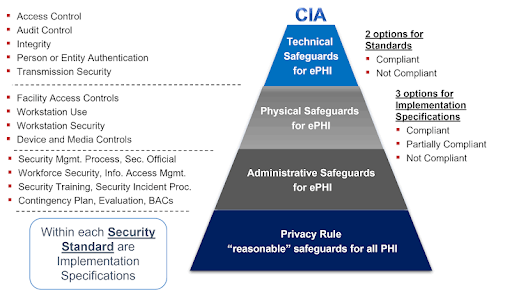
HIPAA Compliance Security Architecture. Source: HIPAA Academy
A signed Business Associate Agreement sets the legal relationship. It doesn’t make an app compliant by itself, and neither does encryption alone.
A documented risk analysis is the real foundation of HIPAA compliant app development. It’s usually the first thing regulators request during an audit.
Must-Have Custom Healthcare App Features
Features depend on the app type, the users, and the workflow. Patient apps typically need registration, scheduling, secure messaging, and records access. Provider apps need patient management, documentation tools, and role-based access. Any app touching PHI needs strong security built in from the start.
Telehealth custom healthcare app features matter most for telemedicine apps. Records access matters most for patient portals. Provider adoption depends on how well features fit existing routines. Added friction means the app sits unused.
Patient | Provider | Admin |
Registration & profile | Patient records access | User management |
Appointment scheduling | Secure messaging | Role-based access control |
Secure messaging | Documentation/notes | Audit logs |
Telehealth/video | Appointment management | Reporting |
Medication reminders | Telehealth capabilities | Analytics dashboard |
Choosing a Healthcare Software Company in the USA
Look at a healthcare software company USA’s track record: healthcare-specific experience, HIPAA knowledge, and history with EHR or FHIR work. Ask how they handle security testing, clinical UX, and post-launch support. Code Avenue builds custom software, mobile apps, and system integrations for healthcare clients. Security gets built in from the start.
Build Your Healthcare App with Code Avenue
Building a digital health platform means finding the right balance between how easy it is for users to interact with the system and keeping data secure. It also means following all the rules and regulations that apply to health information. The system has to work well with other health tech tools and software. Planning the software structure, who will use the system, and what features it will include can save a lot of time and money later on.
If you are starting a digital health company, adding telehealth services to your clinic, or updating your patient portal, working with a team that has experience in digital health development is key. They help keep your project on track and avoid pitfalls.
Ready to begin your health project? Contact Code Avenue today. We can talk about your software needs, how the technology will be built, and how long the development will take.
FAQs
How much does a medical healthcare app development cost?
Costs change with how complicated the healthcare app is. In 2026, a basic MVP might cost around forty thousand to eighty thousand dollars. A middle‑level healthcare app could cost between eighty thousand and two hundred thousand dollars. A complex healthcare app with many connections can cost two‑hundred‑fifty thousand to half a million dollars or more.
How long does healthcare app development take?
The time needed depends on how big the project is, what other systems the healthcare app talks to, and what rules it must follow. A simple healthcare app might be finished in a month. A big healthcare app that talks to an EHR and must pass a compliance check could take many more months.
Does every healthcare app need HIPAA compliance?
Not all healthcare apps. HIPAA only covers hospitals, doctors, and the people who work with them when they use protected health information. If a healthcare app does not work with those covered groups, it might not be under HIPAA. It could still be subject to other rules.
What features should a healthcare app include?
The right custom healthcare app features depend on who uses the healthcare app. Patients usually want to book appointments and send messages. Doctors and nurses need tools to manage patients and write reports. Any healthcare app that deals with protected health information must have security.
Can a healthcare app connect to an EHR?
Yes, most healthcare apps can talk to an EHR. They usually use FHIR, a way to share data, or an older HL7 system. How hard it is depends on which EHR the hospital uses.
How do healthcare apps protect data?
Healthcare apps use layers of protection. They check who is logging in, limit who can see what, lock data in transit and while it sits on a server, keep logs of every action, and run security tests often.
How do I choose a healthcare software company in the USA?
Choose a company that has experience in health software, knows HIPAA rules, has a track record of connecting to EHRs and FHIR tests thoroughly, and offers solid help after launch.










They were willing to walk me through their ideas and provide suggestions when I wasn't sure about something.
Marcus Gitau Founder, Kumea, Agriculture Industry